The best plyometric boxes make jump training, step-ups, box squats, and conditioning more adaptable without requiring a full commercial gym setup.
We compared foam, wood, and steel designs across multiple heights, stability features, portability, and home-gym usability to help you choose with confidence.
Best 10 Plyometric Boxes Picks for 2026
Soft-Impact Versatility
BalanceFrom 3-in-1 Foam Plyo Box

- Rotates between 16, 20, and 24 inches
- High-density foam softens impact
- Lightweight 10-pound design
Best For: Home users seeking adjustable heights and a forgiving training surface
Padded Heavy-Duty Pick

- Wooden core with EVA foam cushioning
- Three heights: 12, 14, and 16 inches
- Rated for up to 440 pounds
Best For: Cushioned training with a stable, high-capacity core
Compact Wood Design

- 12-, 14-, and 16-inch height options
- Interlocking engineered-wood construction
- Built-in handles and textured surface
Best For: Compact home gyms needing a rigid, portable wooden box
High-Capacity Wood Classic
Yes4All 3-in-1 Wooden Plyo Box

- 12-, 14-, and 16-inch training heights
- Supports up to 450 pounds
- Puzzle joints and pre-drilled assembly design
Best For: Users prioritizing a sturdy, high-capacity indoor wooden box
Heavy-Duty Stability Pick

- 500-pound capacity with reinforced steel construction
- Textured top and rubber feet support secure footing
- Stackable 12-inch platform for jumps and conditioning
Best For: Stable home or gym power training
Customizable Soft-Height Pick
Yes4All Adjustable Soft Plyo Box

- Stackable 6-, 12-, 18-, and 24-inch height options
- EPE foam supports up to 440 pounds
- Removable anti-slip cover is easy to clean
Best For: Adjustable, softer plyometric training
Impact-Reducing 3-in-1 Pick

- Flips between 16-, 20-, and 24-inch heights
- Dense foam cushions landings and supports joint comfort
- Seven-pound design with an easy-clean PU cover
Best For: Portable multi-height home workouts
Flexible Stackable Training
Yes4All 3-in-1 Wooden Plyo Box
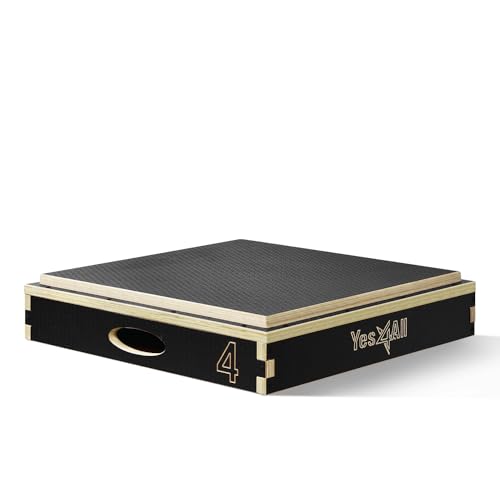
- Stackable heights from 4 to 16 inches
- 22-inch square base with 400-pound capacity
- Hex-patterned surface helps resist slipping
Best For: Customizable home-gym workouts
Soft-Landing Stackable Training
Titan Fitness 12-Inch Soft Foam Plyo Box

- Foam core provides a shock-absorbing landing
- Stackable heights range from 6 to 62 inches
- Supports up to 350 pounds
Best For: Joint-conscious home and garage gyms
Heavy-Duty Steel Versatility
VEVOR 3-Piece Steel Plyometric Jump Box Set

- Includes 12-, 18-, and 24-inch platforms
- Steel construction rated for 500 pounds
- Rubber feet and textured tops support grip
Best For: High-capacity strength and conditioning setups
Soft-Impact Versatility – BalanceFrom 3-in-1 Foam Plyo Box
The BalanceFrom 3-in-1 foam plyometric box is a practical choice for home workouts that combine box jumps, HIIT, step-ups, and agility drills. Rotating the box provides 16-, 20-, and 24-inch training heights, while the high-density foam construction helps soften impact.
Best For: Home users who want adjustable heights, lighter weight, and a forgiving surface for varied training.
Pros:
- Three height options support progressive plyometric workouts.
- High-density foam helps minimize shin scrapes and soften landings.
- Textured non-slip surface supports jumps, step-ups, and landings.
- At 10 pounds, it is relatively easy to move and store.
Cons:
- Its 250-pound maximum weight recommendation is lower than some wooden alternatives.
- Foam construction may not provide the same rigid feel as a wood-core box.
This is a convenient, portable option for general fitness and indoor training, especially when softer contact and quick height changes matter more than a heavy-duty wooden build.
Padded Heavy-Duty Pick – Yes4All Soft-Padded Plyo Box
The Yes4All soft-padded plyometric box combines a wooden core with EVA foam and a vinyl cover for a stable yet cushioned platform. Its three-sided design offers 12-, 14-, and 16-inch heights for box jumps, step-ups, HIIT, and other strength or agility exercises.
Best For: Users who prioritize a cushioned landing surface while wanting a high stated weight capacity.
Pros:
- Wooden core provides a stable foundation for training.
- EVA foam and vinyl cover add cushioning and impact absorption.
- Non-slip PVC surface offers traction and is described as waterproof.
- Supports up to 440 pounds according to the product notes.
Cons:
- Only the 12/14/16-inch size option is detailed for this listing.
- The listed warranty is shorter than some buyers may prefer: 30-day returns and a one-year warranty.
With its padded exterior and wooden core, this box balances comfort and stability well for home-gym users who want a more forgiving alternative to an uncovered wooden plyometric box.
Compact Wood Design – CAP Barbell 3-in-1 Plyo Box
The CAP Barbell 3-in-1 plyometric box is a compact engineered-wood option for box jumps, step-ups, agility drills, and conditioning. Rotating the box gives access to 12-, 14-, and 16-inch heights, while interlocking panels, countersunk screws, and a textured surface support repeated home-gym use.
Best For: Home trainees who want a compact wooden plyometric box with built-in carrying handles.
Pros:
- Three heights make it suitable for progressive training.
- Interlocking construction and countersunk screws are designed for stability.
- Textured surface improves traction during foot placement.
- Integrated handles make repositioning easier.
Cons:
- Its 300-pound maximum weight recommendation is below the stated capacities of some alternatives.
- At 15.4 pounds, it is less lightweight than the foam BalanceFrom option.
This box offers a useful middle ground: a rigid engineered-wood platform with practical portability and multiple heights, suited to compact home-gym setups.
High-Capacity Wood Classic – Yes4All 3-in-1 Wooden Plyo Box
The Yes4All 3-in-1 wooden plyometric box provides 12-, 14-, and 16-inch height options for box jumps, step-ups, split squats, push-ups, and other home-gym movements. Its plywood construction, puzzle joints, pre-drilled holes, and included assembly guidance are designed for a durable indoor training platform.
Best For: Athletes and home users who want a sturdy wooden box with a high stated weight capacity.
Pros:
- Three heights allow users to adjust workout intensity.
- Supports up to 450 pounds according to the supplied details.
- Pre-drilled holes, puzzle joints, instructions, and video tutorials help with assembly.
- Sanded edges and built-in handles improve handling and usability.
Cons:
- At 33 pounds, it is considerably heavier than the foam and smaller engineered-wood options.
- The product is primarily designed for indoor training.
- Wood construction does not provide the same built-in cushioning as padded models.
This is a solid choice when stability and capacity take priority over portability or padding. The adjustable three-in-one profile also makes it practical for progressively challenging workouts.
Heavy-Duty Stability Pick – Steel Plyometric Jump Box
This steel plyometric box is designed for athletes who prioritize stability during explosive training. Its 12-inch height, wide trapezoid base, textured top, and rubber feet make it a practical choice for box jumps, step-ups, and conditioning work.
Best For: Home or gym users seeking a sturdy, compact platform for power and strength training.
Pros:
- Supports up to 500 pounds and uses reinforced alloy steel construction.
- Wide base, textured top, and rubber feet help improve stability and grip.
- Supports box jumps, step-ups, Bulgarian squats, push-ups, and HIIT circuits.
- Stackable design and included setup instructions simplify storage and assembly.
Cons:
- The fixed 12-inch height offers less adjustability than multi-height boxes.
- Steel construction may provide less landing cushioning than a soft foam model.
Choose this model if a firm, stable landing surface and high weight capacity matter more than impact-reducing padding or adjustable heights.
Customizable Soft-Height Pick – Yes4All Adjustable Soft Plyo Box
This adjustable soft plyometric box gives training sessions more height flexibility than a fixed platform. Its EPE foam core, vinyl construction, and stackable 6-, 12-, 18-, and 24-inch options suit users building plyometric exercises around different fitness levels.
Best For: Beginners and families of users who want soft construction with multiple height configurations.
Pros:
- Offers four listed height options from 6 to 24 inches, with stackable configurations.
- EPE foam construction absorbs pressure and supports up to 440 pounds.
- Removable, anti-slip PVC covering improves grip and simplifies cleaning.
- Lightweight design supports indoor and outdoor workouts.
Cons:
- The supplied details identify the included version as a 12-inch model, so other heights may require additional boxes.
- A soft foam surface may feel less rigid than a steel plyometric platform.
- The listed warranty is shorter than the two-year coverage of some alternatives.
This is a flexible choice when adjustable training heights and a softer landing surface are more important than a single rigid platform.
Impact-Reducing 3-in-1 Pick – Goplus Soft Plyo Box
The Goplus 3-in-1 plyometric box changes height simply by flipping the unit, making it convenient for varied home-gym workouts. Its foam core and PU cover provide a softer landing surface for jumps, step-ups, split squats, and other conditioning exercises.
Best For: Users who want three fixed training heights in a lightweight, portable foam box.
Pros:
- Provides 16-, 20-, and 24-inch heights without tools or complicated assembly.
- Dense EPE foam helps cushion landings and reduce impact on joints.
- Tear-resistant, water- and sweat-resistant PU cover wipes clean easily.
- Weighs 7 pounds while supporting up to 352 pounds for convenient transport.
Cons:
- Its 352-pound capacity is lower than the steel and Yes4All alternatives.
- The available heights start at 16 inches, which may be high for some beginners.
- The listed warranty covers manufacturer defects for 90 days.
Consider this box when portability, simple height changes, and impact-reducing foam are priorities for home or studio training.
Flexible Stackable Training – Yes4All 3-in-1 Wooden Plyo Box
For shoppers comparing plyometric boxes, the Yes4All 3-in-1 Wooden Plyo Box stands out for adjustable height and a broad 22-by-22-inch base. Its stackable design supports jumps, step-ups, and box squats at heights from 4 to 16 inches.
Best For: Home-gym users who want a customizable wooden platform for varied training heights.
Pros:
- Five stackable height options: 4, 6, 8, 12, and 16 inches.
- Wide base and plywood construction support up to 400 pounds.
- Hexagon-patterned top helps provide a slip-resistant training surface.
- Available in black or red, with mix-and-match stacking options.
Cons:
- Wooden construction does not offer the shock absorption of a soft foam box.
- The listed configuration is only 2.4 inches tall, so additional pieces may be needed for higher setups.
This is a practical choice when modular height adjustment matters more than a cushioned landing. The stable footprint and 400-pound capacity make it suitable for a range of controlled home workouts.
Soft-Landing Stackable Training – Titan Fitness 12-Inch Soft Foam Plyo Box
The Titan Fitness Soft Foam Plyometric Box is a useful option among plyometric boxes for athletes who prioritize a more forgiving landing surface. Its high-density foam core, grippy vinyl cover, and stackable design support jumps, step-ups, push-ups, and other conditioning exercises.
Best For: Home or garage-gym users seeking a shock-absorbing box with multiple stackable height combinations.
Pros:
- Available in 6-, 12-, 20-, and 24-inch boxes that can stack into more than 20 heights.
- High-density EPE foam supports up to 350 pounds.
- Soft foam construction is designed to help protect shins and joints.
- Velcro flaps, height markings, handles, and a tuck-away zipper aid setup and handling.
Cons:
- The foam model weighs 13 pounds, which may be less substantial than a heavy steel platform.
- Safe use requires landing in the center and placing it on non-slip flooring.
Choose this box if landing comfort and adjustable stacking are central to your training setup. Its 350-pound capacity and grippy cover offer a useful balance for home HIIT and plyometric sessions.
Heavy-Duty Steel Versatility – VEVOR 3-Piece Steel Plyometric Jump Box Set
For buyers wanting durable plyometric boxes with several training levels, the VEVOR set includes 12-, 18-, and 24-inch steel platforms. Its trapezoidal design, rubber feet, and textured silicone tops are intended to provide stability for jumps, step-ups, squats, and other exercises.
Best For: Users who want a three-level steel set with a high stated weight capacity for home-gym conditioning.
Pros:
- Three included boxes provide 12-, 18-, and 24-inch height options.
- Steel construction has a stated 500-pound weight capacity.
- Rubber feet and textured silicone surfaces help with grip and stability.
- Boxes can be stacked or disassembled for storage and portability.
Cons:
- At 39.7 pounds for the set, it is heavier than the foam alternative.
- Assembly is required by tightening the components according to the instructions.
- The steel surface may provide less landing cushioning than a foam box.
This VEVOR set makes sense when durability, high load capacity, and multiple fixed heights are priorities. It is a sturdy, versatile platform system, though users should account for its heavier construction and assembly.
How We Picked the Best Plyometric Boxes
We focused on the features that matter most during repeated jumping and strength sessions: construction, stability, height options, landing comfort, surface grip, portability, and overall versatility. The selection includes 3-in-1 boxes, adjustable designs, stackable foam platforms, and fixed-height steel or wooden options.
Material affects how each box feels in use. Soft foam models are generally more forgiving when a jump is missed, while wooden and steel boxes can provide a firmer, more stable platform for experienced users. We also considered whether each design works for step-ups, split squats, elevated push-ups, box squats, and other non-jumping exercises.
Quick Comparison
| Type | Best For | Main Advantage | Trade-Off |
|---|---|---|---|
| Soft foam | Beginners and home workouts | More forgiving landings | Can feel less rigid |
| Wooden | Experienced jumpers | Firm, stable support | Harder landing surface |
| Steel | Compact training setups | Strong and durable frame | Often less forgiving if contacted |
| Adjustable or 3-in-1 | Mixed users and progression | Multiple training heights | May require more repositioning |
Key Buying Factors for Plyometric Boxes
Height and Adjustability
Choose a height that lets you land under control rather than simply chasing the highest jump. A 3-in-1 box offers multiple orientations, while an adjustable model can make progression easier. Beginners typically benefit from starting lower and increasing height gradually.
Construction and Landing Safety
Look for dense foam, reinforced wood, or a sturdy steel platform that does not wobble. Soft, non-slip covers can reduce the consequences of missed jumps, but the box should still have enough density to resist excessive compression. Check the listed weight capacity and inspect seams, corners, and fasteners regularly.
Grip, Footprint, and Stability
A textured top and rubberized or non-slip base are valuable on smooth floors. A wider footprint generally feels more stable, especially for lateral movements and step-ups. Leave clear space around the box and use it on a level surface.
Storage and Versatility
Measure both the box and your available storage area. Stackable or lighter foam models are convenient for apartments and multipurpose rooms. If you want one piece of equipment for conditioning and strength work, prioritize multiple heights and a sufficiently broad top surface.
Who Should Buy Which Plyometric Boxes?
Beginners and cautious home users: Choose a soft foam box with a non-slip cover and a lower height option. It is usually the most forgiving choice for learning landing mechanics.
Progressive trainers: A 3-in-1 or adjustable box offers more room to increase difficulty without buying several platforms.
Experienced athletes: Wooden or steel boxes can suit users who prioritize rigid support, repeatability, and demanding jump sessions, provided they already have reliable landing technique.
Small-space users: Look for stackable, compact, or lightweight designs that can also function as step platforms. Whatever you choose, match the box to your skill level, floor surface, and intended exercises rather than selecting by maximum height alone.