Fanshaw Premium Dual-Turf Golf Mat review: this is a training mat built for golfers who want one surface that covers tee work, fairway contact, and chipping practice.
It looks aimed at the home-practice buyer who needs a stable, portable setup rather than a fragile display piece.
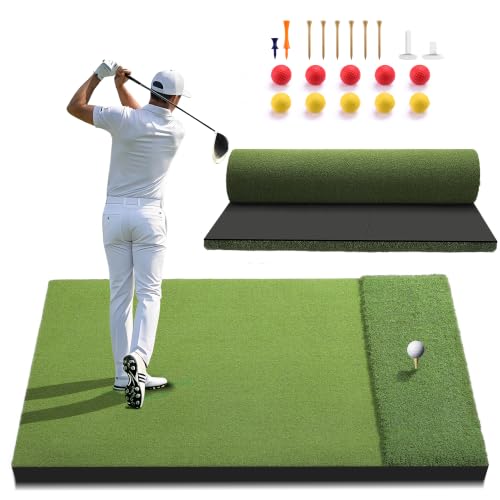
Fanshaw Golf Mat Review Summary
The Fanshaw Premium Dual-Turf Golf Mat makes sense for golfers who want a large practice station with more than one shot pattern in a single footprint.
The listing points to a true tee insertion area, dual turf textures, a thickened EVA foam base, and an anti-slip bottom, so the value proposition is straightforward: practice more kinds of shots without building a whole range setup at home.
Best for golfers who want to rehearse driver contact, basic iron strikes, and chips on a mat that can stay in a backyard, garage, or simulator bay.
Less ideal for players who want a small, ultralight mat or a premium commercial-grade surface with highly detailed construction data.
Review Scorecard
| Category | Score | Why it earns that score |
|---|---|---|
| Practice versatility | 9/10 | Dual turf and tee insertion support more than one shot type. |
| Stability | 8/10 | EVA foam base and anti-slip bottom are well aligned with hard swings. |
| Realism | 8/10 | Rough and fairway zones should create more varied feedback than a single-turf mat. |
| Portability | 7/10 | It rolls up for storage, but the size suggests a real setup rather than a travel toy. |
| Club protection | 8/10 | Thickened foam is a good sign for shock absorption and joint comfort. |
| Value for home practice | 9/10 | The feature set is broad enough to replace multiple smaller practice aids. |
| Buy-with-confidence factor | 7/10 | Strong feature claims, but limited specification detail leaves some unknowns. |
The strongest case for buying this mat is simple: if you actually practice, the dual-turf layout should keep sessions more useful than a plain hitting strip.
It is a smart buy for golfers building a serious at-home routine.
Key Features and Specifications of Fanshaw Golf Mat
The core appeal is the dual-turf design.
The listing describes one area for fairway contact and another that simulates rough, which gives the mat a wider practice range than a single-surface hitting pad.
Another headline feature is the true tee insertion area.
That matters because it lets you use a tee the way you would on a range or tee box, instead of forcing every driver session into an artificial slot or rubber cup.
The mat is listed in larger practice-station sizes, including 5×4 and 6×4 feet variants in the title, and the overall product is positioned for both indoor and outdoor use.
That size makes it more of a dedicated station than a quick-pack accessory.
The base is described as thickened EVA foam with anti-slip support.
In plain buyer terms, that should help with stability, energy absorption, and club protection when you are making repeated swings.
Key listing facts:
- Brand: Fanshaw
- Product type: dual-turf golf hitting mat
- Practice zones: fairway turf and rough turf
- Tee support: true tee insertion
- Base material: thickened EVA foam
- Bottom: anti-slip
- Intended use: indoor, outdoor, backyard, and simulator practice
- Storage: rolls up for compact storage and transport
Pros and Cons of Fanshaw Golf Mat
Pros
- The dual-turf layout gives you more shot variety than a basic hitting strip.
- True tee insertion is a real advantage for driver practice.
- The thicker EVA foam base should be friendlier for clubs and joints than a thin mat.
- The larger footprint makes the mat suitable for structured practice sessions.
- It is positioned for both backyard and simulator use, which broadens its appeal.
Cons
- The listing does not give deep construction details, so durability is harder to judge from the page alone.
- The larger size may be inconvenient for golfers who want something compact and easy to move often.
- If you only need a simple chipping surface, this is probably more mat than necessary.
- The product title is packed with marketing language, which makes the actual buying decision a little noisier than it should be.
For most buyers, the pros matter more than the cons because the mat is not trying to be specialized in only one area.
Its main drawback is not performance so much as scale and uncertainty around the finer details.
Who Should Buy Fanshaw Golf Mat?
Buy this if you want to build a repeatable home practice station and you care about both full swings and short-game reps.
The mat suits golfers who want to hit from a tee, work on contact from fairway-like turf, and practice shots from a rough-like section without changing equipment.
It also fits golfers who use a simulator bay, garage, patio, or backyard setup and want one surface that does more than a cheap strip can do.
The roll-up design is useful here, but this still reads like a semi-permanent practice mat rather than something you throw into a trunk every day.
Skip it if you want the smallest possible footprint, or if your practice is limited to occasional wedge work.
It is also not the best match for someone who needs a very detailed specification sheet before buying.
The Fanshaw mat is for practical golfers, not spec obsessives.
How the Dual-Turf Design Changes Practice
Tee Work and Driver Reps
The tee insertion feature is the clearest differentiator.
It makes the mat more useful for driver practice because you can set a tee naturally and focus on launch, path, and contact instead of adapting to a gimmick.
Fairway Contact
The fairway turf section should be the main striking area for irons and fairway woods.
That gives the mat a more realistic center of gravity for routine practice, especially if you want to work on compression and strike consistency.
Rough and Chipping Practice
The rough turf section adds value for players who want to rehearse awkward lies, partial shots, and chipping control.
That matters because a home mat that only supports clean lies can make practice too easy and less transferable to the course.
Stability and Comfort
The EVA foam base and anti-slip bottom are important even if they sound unglamorous.
For a mat this size, the real job is to stay put, keep the surface from feeling harsh, and protect the user from the repetitive shock that comes with a lot of practice swings.
Alternatives to Fanshaw Golf Mat
If you want a more established golf-mat line, look at Rukket golf mats, which are widely used in home practice setups and often emphasize training durability.
If you want a different premium-style hitting surface, TrueStrike golf mats are a sensible comparison point for golfers who want a more specialized impact feel.
If you want a broad selection of turf and hitting-pad options, Fiberbuilt golf mats are worth checking because the brand is strongly associated with practice-surface design.
If you want a simpler and often more budget-conscious setup, GoSports golf hitting mats are a practical alternative for golfers who do not need as much surface variety.
Is Fanshaw Golf Mat Worth It?
Yes, if your goal is to practice at home in a way that feels closer to real golf than a basic hitting strip can offer.
The Fanshaw Premium Dual-Turf Golf Mat is worth it for golfers who want tee work, fairway reps, and rough-style practice in one large, usable station.
It is not the lightest or simplest option, and the listing leaves some construction details unspecified, so buyers who want exact engineering specs may want to compare alternatives first.
But for a golfer building a serious backyard or simulator routine, this is a credible and useful training mat with a sensible feature mix.