Choosing the right screen matters as much as the launch monitor and projector. The best golf impact screens with low bounceback help reduce recoil, limit noise, and create a safer, more realistic simulator setup.
Below, we focus on practical differences that affect everyday use: layer construction, mounting strength, image quality, and whether a screen is better suited for garages, spare rooms, or full enclosures.
Best 10 Golf Impact Screens with Low Bounceback Picks for 2026
Quiet Dual-Layer Pick
Double Layer Low-Noise Golf Screen
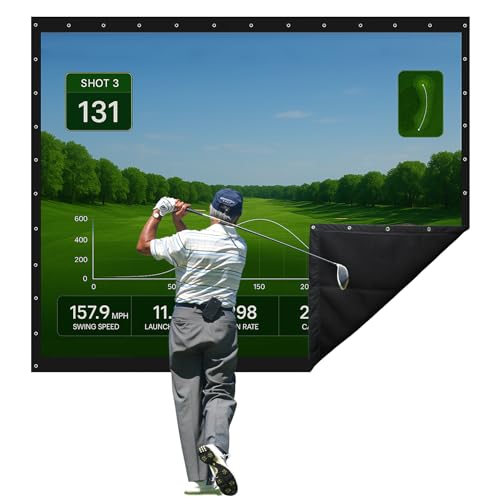
- Double-layer polyester build with black air mesh backing
- Low-noise construction helps soften impact sound
- Reinforced border with heavy-duty grommets on 3 sides
Best For: Indoor setups that need a quieter, reinforced screen
Mesh Value Choice
3D Air Mesh Golf Simulator Screen

- Thickened 3D air mesh polyester fiber build
- Reinforced grommets with included bungee cords
- Mesh layer helps reduce sound resonance
Best For: Golfers wanting an easy-install screen with durable mesh construction
Triple-Layer Stability Pick
Ultra-Quiet 10 x 7.5 Golf Screen

- Triple-layer build with spacer yarn for impact control
- 32 built-in strap fasteners replace external bungees
- Reinforced stitching supports long-term durability
Best For: Users who want a structured, low-noise screen with integrated mounting
Gray Safety-Focused Pick
Fireproof 3D Air Mesh Golf Screen

- Gray 3D mesh helps improve contrast in bright spaces
- Flame-retardant fabric adds a safety-focused feature
- Reinforced edges and grommets support quieter impact
Best For: Home or commercial setups that want contrast, safety, and quieter impact
Triple-Layer Quiet Practice Screen

- Triple-layer design for durability and sound damping
- Built for thousands of impacts
- Includes grommets and bungee cords
Best For: Home or commercial golfers wanting a quiet, durable HD screen
3D Air Mesh Low-Noise Screen

- 3D air mesh build for impact resistance
- Claims 60% noise reduction
- Includes stainless grommets and bungee cords
Best For: Quiet home or garage practice with HD projection
Large Triple-Layer Practice Screen
- Larger 9.8 x 8.5 ft hitting area
- Triple-layer build with sound damping
- Includes grommets and bungee cords
Best For: Users who want more screen coverage in a quiet triple-layer design
Quiet-Play 3D Mesh
Golf Impact Screen, 3D Air Mesh

- Cuts strike noise by up to 60%
- 3D air mesh supports clear HD projection
- Rated for 200 MPH strikes and 100,000 impacts
Best For: Home practice where quieter impact and easy setup matter
Commercial-Grade Enclosure
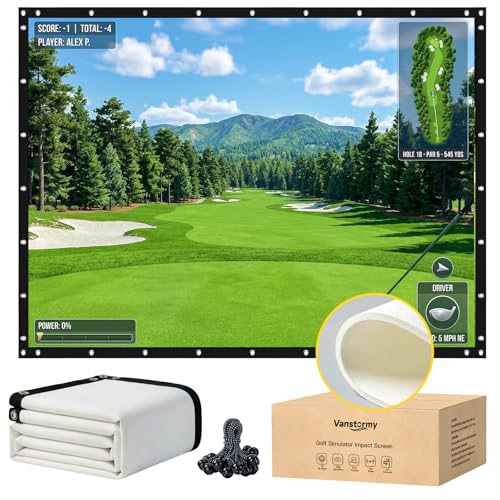
- 3-layer reinforced build for durability
- Over 98% light absorption for cleaner projection
- Offered in 25 size options
Best For: Commercial or high-use setups needing durable impact absorption
Ultra-Thick Silence Mesh

- 5X thicker 3D air mesh build
- Cuts impact noise by up to 60%
- 304 stainless grommets and reinforced edges
Best For: Indoor golfers wanting a rugged, quieter screen for repeated use
Quiet Dual-Layer Pick – Double Layer Low-Noise Golf Screen
If you want golf impact screens with low bounceback that also help cut down on noise, this double-layer model is built for a calmer indoor setup. The white front with black air mesh backing is designed for added strength and durability, while the blackout polyester construction helps soften impact sound for home simulator use.
Best For: Indoor golfers who want a quieter screen with a reinforced, dual-layer build for garages, basements, or simulator rooms.
Pros:
- Double-layer design with white front and black air mesh backing for added durability
- Low-noise construction helps reduce sound on impact
- Reinforced black border and heavy-duty grommets on 3 sides for secure mounting
- Available in two large size options for simulator and practice spaces
Cons:
- Only has grommets on 3 sides, so setup options are more limited than full-perimeter designs
- Best suited to larger spaces because of the available sizes
This is a practical pick if your priority is a sturdier, quieter screen rather than the most minimal build. The dual-layer construction and reinforced edges make it a solid fit for indoor practice where control and durability matter.
Mesh Value Choice – 3D Air Mesh Golf Simulator Screen
For golfers comparing golf impact screens with low bounceback, this 3D air mesh option focuses on durability, sound control, and easy setup. The thickened polyester fiber construction is reinforced at the edges with stainless steel grommets, and the air-layer material is designed to buffer impact and reduce sound resonance during practice.
Best For: Home or indoor golfers who want a durable mesh screen with easy grommet-based installation and multiple size choices.
Pros:
- Thickened 3D air mesh polyester fiber construction for durability
- Reinforced stainless steel grommets and included bungee cords for easier installation
- Mesh air-layer design helps minimize sound resonance
- Compatible with any golf simulator system and offered in multiple sizes
Cons:
- Sound reduction is described as buffering and minimizing resonance, not eliminating noise
- Air-mesh style may appeal more to practicality than premium visual simplicity
This screen is a straightforward choice if you want a durable practice surface that’s easy to hang and works across different simulator setups. The combination of reinforced edges, included accessories, and multiple size options makes it flexible for home use or portable installs.
Triple-Layer Stability Pick – Ultra-Quiet 10 x 7.5 Golf Screen
If you’re shopping for golf impact screens with low bounceback and a heavier-duty feel, this triple-layer design is built around control and tension management. Its spacer-yarn core sits between two polyester layers to absorb impact, while the 32 integrated strap fasteners are meant to distribute mounting tension more evenly and reduce edge stress.
Best For: Golfers who want a strong, low-noise screen with integrated fasteners and a structured, flat setup.
Pros:
- Triple-layer structure with spacer yarn between two impact-resistant polyester layers
- 32 integrated hook-and-loop straps eliminate the need for external bungee cords
- Designed to reduce the sharp crack of impact into a lower thud
- Reinforced stitching at every attachment point for added durability
Cons:
- Smaller 10′ x 7.5′ size may not suit every simulator enclosure
- Mounting is specific to the built-in strap system rather than standard eyelets
This is a smart pick if you want a screen engineered around tension control and a more muted impact sound. The built-in fastening system and reinforced stitching should appeal to users who value a stable setup over a simpler, lighter construction.
Gray Safety-Focused Pick – Fireproof 3D Air Mesh Golf Screen
For buyers comparing golf impact screens with low bounceback, this gray 3D mesh model adds a few practical advantages beyond impact handling. It uses a thick, reinforced mesh fabric to help suppress vibration and sound resonance, while the low-light gray surface is designed to improve projection contrast in naturally lit spaces.
Best For: Indoor or outdoor golfers who want a quieter screen with a gray finish, flame-retardant fabric, and quick setup hardware.
Pros:
- 3D mesh construction with reinforced edges for impact resistance and noise reduction
- Gray surface helps resist ambient light interference and improve image contrast
- Certified flame-retardant fabric adds a safety-focused feature for indoor use
- Includes grommets and bungee cords for quick, flexible installation
Cons:
- Gray color may not be the preferred look for users who want a traditional white screen
- Setup still depends on grommet placement and tension for best flatness
This screen stands out for users who want more than just a durable impact surface. The combination of noise suppression, flame-retardant fabric, and a contrast-friendly gray finish makes it especially practical for home or commercial practice spaces.
Triple-Layer Quiet Practice Screen – Premium 8.2 ft Impact Screen
If you want golf impact screens with low bounceback for a calmer indoor setup, this triple-layer option is built around durability and sound control. The HD outer layer, sound-damping middle layer, and impact-resistant inner layer are aimed at handling repeated use while keeping practice quieter.
Best For: Home golfers or commercial setups that want a durable, quiet screen with clear HD visuals.
Pros:
- Triple-layer build combines an HD face, sound damping, and impact resistance.
- Designed for thousands of ball impacts for long-term use.
- Includes reinforced grommets and bungee cords for secure setup.
- HD surface supports clear ball-to-screen visibility for shot analysis.
Cons:
- Size is fixed at 8.2 x 8.2 ft, so it may not fit every enclosure.
- Material is polyester, which may not suit buyers looking for mesh construction.
Overall, this screen is a solid pick if your priority is a tougher, quieter practice screen with a smooth projection surface and straightforward installation. It balances durability and visual clarity without adding extra setup complexity.
3D Air Mesh Low-Noise Screen – HD 8.2 ft Practice Screen
For golfers comparing golf impact screens with low bounceback, this 3D air mesh model emphasizes impact resistance and noise reduction. The thick fabric, reinforced edges, and tight weave are designed to keep shots stable on contact while supporting HD projection.
Best For: Golfers who want a quieter, impact-resistant screen for home, garage, basement, or outdoor practice.
Pros:
- 3D air mesh construction is tested for high-speed shots and heavy impact use.
- Claims 60% noise reduction thanks to thick fabric and reinforced edges.
- Supports HD projection with zero pixel blur and light leakage.
- Includes stainless steel grommets and bungee cords for quick setup.
Cons:
- Warranty is listed at 6 months.
- At 8.2 x 8.2 ft, the square size may not suit every simulator frame.
This is a practical choice if you want a screen that prioritizes quiet operation, strong impact handling, and flexible placement. Its mesh build and reinforcement details make it a strong fit for everyday simulator use.
Large Triple-Layer Practice Screen – Premium 9.8 ft Impact Screen
If you need golf impact screens with low bounceback and a larger hitting area, this triple-layer model offers the same sound-damping construction in a bigger 9.8 x 8.5 ft size. The layered polyester build is designed for frequent impact use while keeping practice sessions quieter and visually clear.
Best For: Golfers who want a larger triple-layer screen for home practice or a busier facility.
Pros:
- Triple-layer construction combines HD visuals, sound damping, and impact resistance.
- Designed to withstand thousands of ball impacts.
- Larger 9.8 x 8.5 ft size gives more hitting coverage than the smaller version.
- Includes reinforced grommets and bungee cords for secure mounting.
Cons:
- Only the material, size, and included components are listed; there are fewer construction details than the 8.2 ft version.
- Its larger footprint may be harder to fit in compact spaces.
As a bigger-format version of the triple-layer design, this screen makes sense if you need more coverage without giving up the quiet, durable feel. It is a straightforward upgrade for users who want roomier practice sessions.
Quiet-Play 3D Mesh – Golf Impact Screen, 3D Air Mesh
If you want golf impact screens with low bounceback for a quieter home setup, this 3D air mesh option is built to absorb impact and reduce strike vibration. It’s designed for HD projection, durable training, and easy installation in garages, basements, or outdoor practice areas.
Best For: Home golfers who want a low-noise impact screen with fast setup and broad simulator compatibility.
Pros:
- 3.45mm fabric and reinforced edges are designed to reduce impact noise by up to 60%.
- 3D air mesh helps avoid pixel blur and light leakage for clearer projection.
- Rated for 200 MPH strikes and 100,000 impacts for long-term practice use.
- Includes webbing buckles and bungee cords for quick 3-minute setup.
Cons:
- Only one size is listed, so fit may be less flexible than multi-size options.
- Warranty coverage is limited to 6 months.
Overall, this is a practical pick if quiet performance matters as much as impact durability. It balances low bounceback behavior with projector-friendly clarity and simple installation.
Commercial-Grade Enclosure – Golf Simulator Impact Screen
For golfers comparing golf impact screens with low bounceback, this heavy-duty 3-layer design focuses on durability, impact absorption, and stable projection. The thickened sandwich mesh and reinforced perimeter make it a strong fit for repeated training in garages, basements, and studio-style enclosures.
Best For: Golfers and facilities that want a commercial-grade screen with multiple size options and strong impact absorption.
Pros:
- 3-layer reinforced structure is built for long-term tear resistance and impact absorption.
- Over 98% light absorption helps create sharp HD projection with less glare or ghosting.
- Grommets spaced 20-30 cm apart make tensioning and installation straightforward.
- Available in 25 size options for more setup flexibility.
Cons:
- Heavier commercial construction may be more than casual users need.
- Install still requires proper tensioning for best results.
This is a solid choice if you want a more commercial-style screen that can handle frequent use. Its main strengths are durability, strong light control, and broad sizing.
Ultra-Thick Silence Mesh – Golf Simulator Impact Screen
If your priority is golf impact screens with low bounceback, this 3D air mesh model is tuned for heavy-duty use and noise reduction. It combines thick fabric, reinforced edges, and stainless grommets to support repeat hitting while keeping setup simple.
Best For: Golfers who want a thicker impact screen with strong noise dampening and rugged mounting hardware.
Pros:
- 5X thicker 3D air mesh is lab-verified for 200+ MPH ball speeds and 100,000+ impacts.
- Designed to cut hit noise by up to 60% for quieter indoor practice.
- Reinforced webbing edges and 304 stainless steel grommets add durability and rust resistance.
- Comes with bungee cords for a quick, tool-free 3-minute setup.
Cons:
- Premium construction may be more than basic practice setups require.
- At 11.8 x 8.8 ft, it may need a larger dedicated space.
This screen stands out for users who want a tougher build and quieter impact behavior in one package. It’s a strong fit for home or pro environments where durability and low-noise play both matter.
How We Picked the Best Golf Impact Screens with Low Bounceback
For this roundup, we looked for screens that balance impact absorption with a clean hitting surface and reliable mounting. Priority went to models with multi-layer construction, air-mesh designs, reinforced borders or grommets, and materials that are commonly used for indoor simulator builds. We also considered whether each option is suitable for repeated driver use, projector clarity, and home-friendly noise control.
Quick Comparison
In general, triple-layer screens tend to offer the best mix of durability and reduced rebound, while 3D air mesh screens often excel at easing impact and lowering noise. Double-layer options can be a solid budget-friendly middle ground. If you want the sharpest projected image, look for tighter woven surfaces and screens designed specifically for launch monitor or projector use.
Key Buying Factors for Golf Impact Screens with Low Bounceback
Material and Layering
Layer count is one of the biggest clues to how a screen will behave under impact. More layers can improve energy absorption and help reduce bounceback, but the fabric still needs to be tensioned correctly to avoid excessive sag or wrinkling.
Mounting and Frame Support
A screen with strong grommets, reinforced edges, or multiple mounting points is easier to install securely. Good tensioning matters because a loose screen can rebound more than a properly mounted one.
Noise and Durability
If you practice in a garage or shared space, quieter screens are worth prioritizing. Dense polyester, reinforced seams, and air-mesh construction can help soften impact sound while improving long-term wear.
Visual Performance
Some Golf Impact Screens with Low Bounceback are also designed for better projector performance. If you want a clear simulator image, check that the screen is intended for HD projection and not just net-style ball stopping.
Who Should Buy Which Golf Impact Screens with Low Bounceback?
Choose a triple-layer screen if you want the strongest all-around option for frequent practice and maximum rebound control. Pick a 3D air mesh screen if noise reduction and softer impact are your top priorities. A double-layer screen can make sense if you want a simpler, more affordable setup without giving up the core benefits of a simulator screen.
For most home golfers, the best choice is the model that fits both your space and your mounting setup. Measure carefully, leave enough room for safe ball flight, and match the screen to your enclosure, projector, and practice volume.