Choosing the right golf ball feeder can make practice faster, safer, and more consistent for players and facilities alike.
This roundup of commercial golf ball dispensers focuses on capacity, durability, power requirements, and compatibility so you can match the right model to your setup.
Best 10 Commercial Golf Ball Dispensers Picks for 2026
Heavy-Duty Metal Pick
Automatic Golf Ball Tee Up Machine

- 3-second ball dispensing for steady practice
- 50-ball capacity with adjustable height settings
- Metal build designed for durability and stability
Best For: Home simulators and training spaces needing a durable ball feeder
Multi-Function Practice Hub
JJM Automatic Driver for Indoor Simulators

- Automatic teeing for indoor, net, and range practice
- Built-in club holder and phone bracket
- 100-ball capacity with two ball guide tracks
Best For: Golfers who want a feature-packed practice station
All-In-One Trainer
WBM Automatic Golf Tee Machine

- One-click automatic teeing for easier practice
- Built-in phone holder and 9-hole club holder
- About 100-ball capacity with two hitting tracks
Best For: Practicing golfers who want extra built-in convenience
Commercial Tray Upgrade
DCQ Golf Ball Tray with Cell Phone Holder

- Universal fit for all golf hitting mats
- Holds up to 100 golf balls
- Heavy-duty rubber with built-in phone holder
Best For: Simple, durable mat-side practice setups
Backyard Practice Pick
Automatic Golf Ball Dispenser with Large Hopper

- Oversized funnel speeds reloading
- Gravity-fed design aims to reduce jams
- Heavy-duty plastic for range or backyard use
Best For: Golfers wanting a simple, no-power practice dispenser
Commercial Range Staple
Heavy Duty Golf Ball Tray Dispenser

- Commercial-quality tray for daily use
- Heavy-duty build for driving ranges
- Keeps balls organized and easy to reach
Best For: Ranges and practice bays needing a rugged ball tray
Automation Leader
Automatic Golf Tee Machine with 100-Ball Capacity
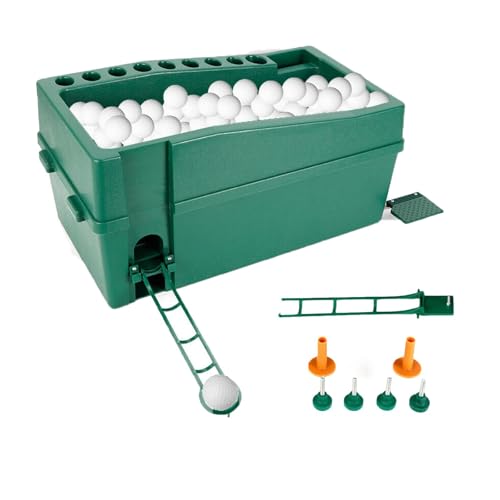
- Holds up to 100 balls
- Includes wood and iron practice tracks
- Comes with pedal, stands, and phone holder
Best For: Users wanting an automated tee-up machine with large capacity
Range Reload Pick
Automatic Golf Ball Tee Up Machine for Driving Range

- Pedal feed delivers a ball about every 3 seconds.
- Holds 60 balls for 30+ minutes of practice.
- Steel, no-electronics design is rain-resistant.
Best For: Golfers who want uninterrupted practice and a durable mechanical feeder.
All-Around Trainer
Golf Ball Dispenser with Adjustable Stand

- Foot pedal feed keeps practice hands-free and steady.
- Adjustable height fits tees, mats, simulators, and nets.
- 60-ball steel design suits indoor and outdoor use.
Best For: Golfers who need a flexible dispenser for multiple practice setups.
Compact Feed Pro
Foot Pedal Automatic Golf Ball Dispenser

- 50-ball capacity keeps the footprint smaller.
- Angled rail design is meant to help prevent jams.
- Galvanized steel build adds rust resistance and stability.
Best For: Golfers who need a compact dispenser for smaller practice areas.
Heavy-Duty Metal Pick – Automatic Golf Ball Tee Up Machine
If you want commercial golf ball dispensers that keep practice moving, this metal tee-up machine is built for steady, hands-free feeding. It dispenses a ball every 3 seconds, holds up to 50 balls, and uses an angled internal design to help reduce jams during repeat sessions.
Best For: Home simulators, garages, backyards, driving ranges, and coaching setups that need a durable, low-maintenance ball feeder.
Pros:
- 3-second dispensing keeps practice rhythm consistent.
- 50-ball capacity reduces refill stops.
- Metal construction adds stability and durability.
- Adjustable height settings help fit different practice setups.
Cons:
- 90-day warranty is not as long as some competitors.
- Heavier metal build may be less portable than plastic options.
This is a solid pick if durability and smooth feeding matter more than extra features. Its straightforward design focuses on reliable ball delivery for frequent practice use.
Multi-Function Practice Hub – JJM Automatic Driver for Indoor Simulators
This commercial golf ball dispenser is designed for golfers who want more than just automatic teeing. It works in indoor simulators, outdoor practice nets, and driving ranges, and its gentle foot-pedal operation helps keep balls moving without repeated setup.
Best For: Players and practice bays that benefit from built-in accessory storage and a larger ball capacity.
Pros:
- Automatic teeing supports simulator, net, and range use.
- Built-in 9-hole club holder and phone bracket add convenience.
- Two ball guide tracks support wood shot and iron shot practice.
- 100-ball capacity reduces refill frequency.
Cons:
- ABS construction may not feel as premium as metal units.
- 90-day warranty is relatively short.
The JJM unit stands out for combining teeing, storage, and filming support in one setup. If you want a more feature-rich practice station, it offers a practical all-in-one approach.
All-In-One Trainer – WBM Automatic Golf Tee Machine
For buyers comparing commercial golf ball dispensers, this WBM model offers automatic ball teeing plus practice-friendly extras. It is made for indoor simulators, outdoor nets, and driving ranges, and it can dispense a ball with one click so you spend less time resetting between swings.
Best For: Practicing golfers who want an automatic tee machine with built-in storage and putting-related accessories.
Pros:
- One-click automatic teeing helps streamline practice.
- Built-in 9-hole club holder and phone holder add functionality.
- Two hitting tracks support wood and iron practice.
- About 100-ball capacity supports long sessions.
Cons:
- ABS plastic build may not suit those looking for metal construction.
- Warranty is limited to one year.
This model is a good fit if you want a practice machine with more built-in utility than a basic dispenser. The adjustable base and broad practice compatibility make it versatile for different setups.
Commercial Tray Upgrade – DCQ Golf Ball Tray with Cell Phone Holder
If you need commercial golf ball dispensers in tray form rather than a powered feeder, this DCQ model is built for straightforward mat-side use. It fits all golf hitting mats, holds up to 100 balls, and adds a built-in phone holder for filming or following training content hands-free.
Best For: Indoor and outdoor practice stations that need a durable, no-installation ball tray with phone support.
Pros:
- Universal fit works with all golf hitting mats.
- No installation required for quick setup.
- 100-ball capacity supports uninterrupted practice.
- Heavy-duty rubber construction is made for commercial use.
Cons:
- It is a tray, not an automatic teeing machine.
- Does not include extra accessories beyond the built-in phone holder.
This DCQ tray is a practical choice when simplicity and durability matter most. The drainage holes are a useful touch for keeping balls dry in changing conditions.
Backyard Practice Pick – Automatic Golf Ball Dispenser with Large Hopper
If you want commercial golf ball dispensers that keep practice moving without extra setup, this gravity-fed model is built for quick refills and steady ball delivery. The oversized funnel is designed to guide balls into the magazine with fewer spills, while the no-power design makes it easy to use in a driving range bay, backyard, or indoor practice area.
Best For: Golfers who want a simple, manual, high-capacity dispenser for repetitive practice sessions.
Pros:
- Large, wide-mouth funnel helps speed up reloading and reduce mess.
- Gravity-fed track is designed for smoother ball flow and fewer jams.
- Heavy-duty high-density plastic construction is made for repeated outdoor use.
- No power needed, so it works for backyard or range practice setups.
Cons:
- Unassembled packaging means you should expect basic setup before use.
- Primarily focused on ball dispensing rather than added training features.
Overall, this is a practical pick if you value simple operation and fast reloads over electronics or extra automation. It’s a straightforward way to keep reps flowing and spend more time swinging.
Commercial Range Staple – Heavy Duty Golf Ball Tray Dispenser
Among commercial golf ball dispensers, a tray-style holder like this is useful when you need balls organized and immediately accessible at a driving range or practice station. Its heavy-duty, commercial-quality construction is meant for repeated daily use, and the larger footprint gives it a more permanent setup feel than compact home units.
Best For: Driving ranges, golf courses, and practice areas that need a rugged, easy-access ball tray.
Pros:
- Commercial-quality build is intended for rigorous daily use.
- Heavy-duty construction is designed to handle high-impact use.
- Large tray format keeps golf balls organized and accessible.
- Works for both professional ranges and personal practice spaces.
Cons:
- Tray design does not offer automatic ball loading or teeing.
- Product details are limited compared with more feature-rich machines.
This is a solid choice if your priority is durability and simple ball access rather than automation. It fits best where a sturdy, commercial-style holder is more useful than a powered practice system.
Automation Leader – Automatic Golf Tee Machine with 100-Ball Capacity
If you’re comparing commercial golf ball dispensers for more automated practice, this tee machine stands out with its 100-ball capacity and included batting stand setup. It’s designed for indoor simulation, private practice, and driving range use, and the dual track system supports both wood and iron practice modes.
Best For: Beginners, enthusiasts, and professionals who want a large-capacity automatic tee-up machine.
Pros:
- Holds up to 100 balls, reducing how often you need to reload.
- Includes wood mode and iron mode tracks for different practice styles.
- ABS construction is described as sturdy and wear-resistant.
- Comes with accessories like a foot pedal, mesh stands, batting stands, and a phone holder.
Cons:
- More complex than a basic tray or manual dispenser.
- Primarily aimed at tee-up practice rather than simple ball storage.
This model is the most feature-packed option here and makes sense if you want automation plus a larger practice setup. It is best suited to users who want fewer interruptions and more structured reps.
Range Reload Pick – Automatic Golf Ball Tee Up Machine for Driving Range
If you want commercial golf ball dispensers that keep practice moving without constant bending or ball resets, this Range Reload model is built for a smooth rhythm. It uses a pedal-activated mechanical feed to deliver a new ball about every 3 seconds, holds up to 60 balls, and is designed for use on the range, in a simulator setup, or at home.
Best For: golfers who want hands-free, uninterrupted practice with a durable, rainproof mechanical feeder.
Pros:
- Pedal-activated feed helps eliminate bending and keeps swing rhythm steady.
- 60-ball capacity supports 30+ minutes of continuous practice.
- Four adjustable legs help level the unit on uneven ground or mats.
- All-steel build has no electronics, so it is rain-resistant and simple to use.
Cons:
- Mechanical design means no powered automation or advanced features.
- Weight and steel construction may feel less convenient than lighter plastic units.
Overall, this is a practical choice for golfers who value reliability, portability, and a consistent ball feed over bells and whistles. It fits well for year-round practice in multiple environments.
All-Around Trainer – Golf Ball Dispenser with Adjustable Stand
Among commercial golf ball dispensers, this model focuses on simple, repeatable training with a hands-free foot pedal and a steady 3-second feed cycle. The 60-ball capacity and height-adjustable stand make it a flexible option for backyard nets, indoor simulators, and range sessions where consistency matters.
Best For: golfers who want a sturdy, adjustable dispenser for indoor and outdoor practice setups.
Pros:
- Foot pedal operation helps avoid bending between shots.
- 60-ball capacity supports extended practice without frequent refills.
- Adjustable height works with standard tees, mats, simulators, and nets.
- Cold-rolled steel construction is built for indoor and outdoor use.
Cons:
- Steel build may be less portable-feeling than lighter-duty options.
- Mechanical setup is straightforward rather than feature-rich.
This is a solid pick if you want a dependable, all-purpose practice feeder that can move between different training spaces. Its adjustable stand is especially useful if you use more than one teeing surface.
Compact Feed Pro – Foot Pedal Automatic Golf Ball Dispenser
If you’re comparing commercial golf ball dispensers for a smaller practice space, this 50-ball feeder keeps the setup simple and efficient. It uses a foot pedal trigger for hands-free ball feeding, and its angled internal design is meant to help deliver smooth, steady output while reducing jams.
Best For: golfers who want a compact, durable feeder for home, garage, or simulator practice.
Pros:
- Foot pedal activation eliminates repeated bending.
- Gravity slide rail and angled design are intended to reduce ball jams.
- Galvanized steel construction offers rust and corrosion resistance.
- Built-in carry handle makes it easier to move and store.
Cons:
- 50-ball capacity is smaller than some larger-capacity alternatives.
- No adjustable stand or height settings are listed.
This model makes sense if you want a straightforward, metal-built dispenser that prioritizes smooth feeding and portability over extra adjustability. It should suit golfers who practice in tight spaces or rotate between locations.
How We Picked These Commercial Golf Ball Dispensers
We focused on Commercial Golf Ball Dispensers that fit real-world practice needs: sturdy construction, practical ball capacity, smooth tee-up or feed operation, and compatibility with driving ranges, indoor simulators, and hitting mats. We also looked at whether a unit needs power, how easy it is to move or store, and whether it supports repeat use in higher-traffic environments.
Quick Comparison
In general, larger-capacity dispensers reduce refilling frequency, while compact models are easier to place in simulator bays or smaller training areas. Foot-pedal and automatic tee-up designs are better for faster repetition, while no-power options can be a strong fit for simpler range setups or locations where electrical access is limited.
Key Buying Factors for Commercial Golf Ball Dispensers
Capacity and Throughput
Capacity matters most when the dispenser will see frequent use. A 50-ball unit may be enough for a compact simulator bay, but 60-ball and 100-ball designs can better support lessons, practice sessions, and range operations with fewer interruptions.
Durability and Build Quality
For commercial use, look for metal frames, heavy-duty trays, reinforced feeders, and materials that can tolerate repeated contact and daily wear. Rubber components can help protect balls and reduce slippage, but structural strength should be the priority.
Power, Pedal, or Manual Operation
Some Commercial Golf Ball Dispensers use foot pedals for hands-free convenience, while others are automatic or require no power at all. Choose the control style that best matches your workflow, staffing, and space. Hands-free operation is useful for teaching and simulator use, while no-power models may be easier to maintain.
Compatibility with Mats and Simulators
Check whether the dispenser works with your hitting mat, simulator bay, or driving range layout. Height adjustability, tee stability, and tray design can make a major difference in setup consistency and user experience.
Who Should Buy Which Commercial Golf Ball Dispensers?
If you manage a busy range, prioritize capacity, steel or metal construction, and reliable automatic or pedal-based feeding. If you run an indoor simulator, focus on compact size, height adjustability, and compatibility with your mat system. If you want the simplest setup with minimal maintenance, a no-power dispenser may be the best fit. For teaching facilities, hands-free operation and quick ball access can improve pacing and lesson flow.
The best choice is the one that matches your traffic level, space constraints, and maintenance preferences. Used well, Commercial Golf Ball Dispensers can streamline practice and keep sessions moving efficiently.