Not every hitter has room for a full backyard setup. The best baseball pitching machines for small spaces make it possible to practice in garages, driveways, batting cages, and other tight areas without sacrificing repeatable reps.
This roundup focuses on compact, portable, and easy-to-use options that fit real-world training spaces for youth players, families, and coaches.
Best 10 Baseball Pitching Machines for Small Spaces Picks for 2026
Manual Multi-Ball Trainer
Louisville Slugger Blue Flame Pitching Machine

- No electricity or batteries needed
- Throws baseballs, softballs, and more
- Lightweight and easy to move
Best For: Portable drills in spaces where power and flexibility matter
Step-On Soft Toss Trainer
Furlihong 898BH Baseball Soft Toss Machine

- No power supply required
- Three angle settings for training
- Durable mechanical design
Best For: Simple soft toss reps in compact training areas
Game-Speed Manual Thrower
Louisville Slugger Black Flame Pitching Machine

- Up to 50 mph for baseballs
- No electricity or batteries needed
- Three practice modes in one machine
Best For: Realistic batting and fielding reps in no-power setups
Youth Auto Pitch Trainer
Franklin Sports MLB Electronic Baseball Pitching Machine

- Automatic pitches every 7 seconds
- Angle-adjustable for youth drills
- Includes 6 plastic baseballs
Best For: Young hitters practicing with a compact electronic machine
Compact Training Pick
Furlihong 692BH Baseball Pitching Machine

- Uses smaller 5-inch training balls for focused reps
- Runs on AC power or C batteries for portable use
- Includes 60 balls and an up-to-40-ball top basket
Best For: Small-space batting practice with training balls
Serious Youth Upgrade
Junior Hack Attack Baseball Pitching Machine

- Offers adjustable pitch location, speed, and angle
- Throws multiple pitch types up to 70 mph
- Baseball-only machine with reliable feeding
Best For: Advanced youth training and coaching drills
Budget Play Pick
Franklin Sports MLB Power Pitcher Pitching Machine
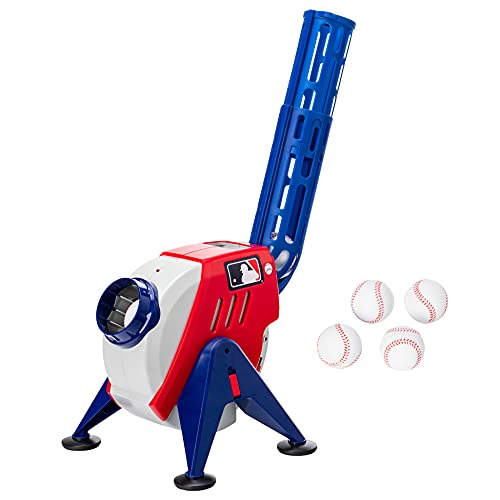
- Three speed settings from 10 to 20 mph
- Includes 4 foam balls and feeds up to 9
- Battery powered with 3-angle adjustment
Best For: Kid-friendly batting practice in limited spaces
Manual Trainer for Any Field
MOXOW Sagitta Manual Baseball & Softball Pitching Machine

- Fully manual with no electricity or charging required.
- Anti-tilt structure supports more consistent accuracy.
- Ball caddy holds up to 50 baseballs or 30 softballs.
Best For: Portable practice for batting, fielding, and backyard drills
Compact Auto Feeder for Kids
Heater Sports Junior Baseball Pitching Machine

- 12-ball automatic feeder supports hands-free practice.
- Speed adjusts from 15 to 48 MPH.
- Heavy-duty tripod stand improves stability.
Best For: Kids’ backyard practice with repeatable automatic feeds
Lightweight Backyard Feeder
Heater Sports Base Hit Adjustable Baseball Pitching Machine

- Weighs 15 lbs for easier transport and storage.
- 12-ball feeder releases one ball every 8 seconds.
- Adjustable head works for ground balls and pop flies.
Best For: Portable batting and fielding practice in tighter spaces
Manual Multi-Ball Trainer – Louisville Slugger Blue Flame Pitching Machine
If you need baseball pitching machines for small spaces, the Louisville Slugger Blue Flame is a practical manual option that keeps setup simple and doesn’t require electricity or batteries. It throws a wide range of balls, adjusts speed easily, and stays light enough to move between drills or fields.
Best For: Coaches and players who want a portable, no-power machine for varied batting and fielding drills.
Pros:
- Completely manual, so it works anywhere without power or batteries
- Throws hard balls, softballs, light flight, plastic, soccer, and volleyballs
- Adjustable speed range from 18 to 45 mph for hard balls and up to 60 mph for light balls
- Lightweight at under 25 lbs. for easier moving and storage
Cons:
- Manual operation means it is not automatic
- Designed as a machine for drills rather than a compact tabletop unit
This is a strong choice if you want one machine that can cover strikes, fly balls, and grounders without needing an outlet. Its portability and broad ball compatibility make it useful for small-space training setups that still need versatility.
Step-On Soft Toss Trainer – Furlihong 898BH Baseball Soft Toss Machine
For buyers comparing baseball pitching machines for small spaces, the Furlihong 898BH stands out as a compact, no-power soft toss trainer with a simple step-on release. Its adjustable angles and mechanical design make it a straightforward option for batting practice without adding electrical clutter.
Best For: Coaches and players who want a mechanical soft toss machine for basic training sessions.
Pros:
- No power supply needed, so it can be used anywhere
- Three adjustable angles for different ages and training needs
- Mechanical design is built for durability over seasons of use
- Can work with extra stackers to hold more balls and reduce loading time
Cons:
- Uses a step-on-and-release action rather than fully automatic pitching
- Primarily a soft toss trainer, so it is less versatile than full pitching machines
Overall, this is a focused practice tool for users who value simplicity and a smaller training footprint. It is best when you want repetitive soft toss reps without the need for electricity or complex setup.
Game-Speed Manual Thrower – Louisville Slugger Black Flame Pitching Machine
If you are shopping for baseball pitching machines for small spaces, the Louisville Slugger Black Flame gives you game-speed reps without needing electricity. It is manual, easy to anchor, and can switch between strikes, fly balls, and grounders, which makes it a flexible practice tool for limited setups.
Best For: Coaches, teens, and adults who want a manual machine for realistic batting and fielding practice.
Pros:
- Throws regulation baseballs up to 50 mph and softballs up to 44 mph
- Completely manual and works without electricity or batteries
- 3-in-1 design can throw strikes, high fly balls, and ground balls
- Compatible with multiple ball types, including dimple, restricted-flight, plastic, and foam balls
Cons:
- Weighs 22 lbs., so it is less lightweight than some smaller practice tools
- Still requires enough space for safe ball flight and setup
This model is a good fit when you want realistic speeds and more than one drill mode in a no-power design. It balances versatility and portability well for backyard or field use where space is limited but training needs are not.
Youth Auto Pitch Trainer – Franklin Sports MLB Electronic Baseball Pitching Machine
For families looking at baseball pitching machines for small spaces, the Franklin Sports MLB Electronic Pitching Machine offers a compact youth-friendly setup with automatic pitches every 7 seconds. The adjustable angle and included plastic balls make it a convenient backyard practice option for young hitters.
Best For: Young players who want a simple electronic batting practice machine with included balls.
Pros:
- Pitches every 7 seconds for repeated practice
- Angle is adjustable for different batting drills
- Includes 6 plastic baseballs and can hold up to 9 balls
- Compact assembled size makes it manageable for backyard use
Cons:
- Should not be used with regulation baseballs or tee balls
- Best paired with a plastic baseball bat, which adds another gear requirement
This is a solid starter machine for kids who need predictable reps in a smaller practice area. Its simplicity is the main appeal, especially if you want an automatic feeder style trainer with included balls.
Compact Training Pick – Furlihong 692BH Baseball Pitching Machine
If you need baseball pitching machines for small spaces, the Furlihong 692BH is built around compact training. It uses smaller 5-inch training balls and pitches them at up to 18 mph, which makes it a practical option for focused batting reps without needing a large setup. The portable design can run on AC power or C batteries, so it can move between indoor and outdoor use.
Best For: Young players, trainers, and small-space practice with training balls.
Pros:
- Compact machine with a small footprint and portable power options
- Includes 60 training balls, so it is ready to use right away
- Adjustable height helps dial in the pitching angle
- Top basket holds up to 40 balls for longer practice runs
Cons:
- Uses special 5-inch training balls rather than standard baseballs
- Top speed is 18 mph, which is aimed more at practice than advanced batting
This is a solid choice if your priority is simple, space-conscious training with included balls and easy setup. It is less about power and more about making small-area reps repeatable and convenient.
Serious Youth Upgrade – Junior Hack Attack Baseball Pitching Machine
Among baseball pitching machines for small spaces, the Junior Hack Attack stands out for controlled, high-end training rather than a tiny footprint. It offers adjustable pitch location and speed, throws a wide range of pitches up to 70 mph, and can pivot for defensive drills, giving coaches a lot of training flexibility in a compact practice environment. It is built for baseballs only and is meant for serious repetition.
Best For: Serious young players and coaches who want advanced pitch variety in a controlled space.
Pros:
- Adjustable pitch location and speed for tailored sessions
- Throws fastballs, curveballs, sliders, split fingers, and knuckle balls
- Can pivot for ground balls, line drives, and fly ball practice
- Handles standard baseballs reliably
Cons:
- Baseball-only design, so softballs will not fit
- More machine than a casual backyard toy
This model makes sense if you want advanced training options and reliable feeding in a smaller practice area. It is a better fit for structured coaching than for simple recreational use.
Budget Play Pick – Franklin Sports MLB Power Pitcher Pitching Machine
If you are shopping for baseball pitching machines for small spaces, the Franklin Sports MLB Power Pitcher is a simple entry-level option. It pitches foam baseballs at 10, 15, or 20 mph, includes 4 balls, and cycles every 7 seconds, making it easy to set up for kids who need a predictable rhythm in a limited play area. The 3-angle adjustment also helps you tweak the launch direction.
Best For: Kids and families who want a simple battery-powered pitching toy for light practice.
Pros:
- Three speed settings: 10, 15, or 20 mph
- 3-angle adjustment adds some flexibility
- Includes 4 foam baseballs and holds up to 9 balls
- Battery powered for easy portable play
Cons:
- Batteries are not included
- Foam balls make it better for casual use than serious training
For light, kid-friendly batting practice, this machine keeps things straightforward. It is best viewed as a fun practice toy that works well when you do not need advanced features or hard-thrown pitches.
Manual Trainer for Any Field – MOXOW Sagitta Manual Baseball & Softball Pitching Machine
If you want baseball pitching machines for small spaces that still cover a lot of drills, the MOXOW Sagitta is built around portability and simple manual use. It delivers consistent throws for batting and fielding practice, and the anti-tilt design helps keep pitches on target. Because it does not need electricity, batteries, or charging, it works well for backyard sessions or quick setup on any field.
Best For: Players and teams that want a manual, portable machine for strikes, grounders, and fly balls without needing power.
Pros:
- Fully manual, so there is no need for electricity, batteries, or charging.
- Anti-tilt structure helps prevent side-leaning for more accurate pitches.
- Includes a ball caddy that holds up to 50 baseballs or 30 softballs.
- Can be adjusted for strikes, grounders, and fly balls.
Cons:
- Ball caddy and balls are separate pieces to manage during practice.
- Manual operation means it is less automated than feeder-based machines.
For small-space training, the biggest advantage here is flexibility: you can set it up without power and use it for several drill types. It is a practical choice if you value simple transport, stable pitching, and efficient ball collection over fully automatic operation.
Compact Auto Feeder for Kids – Heater Sports Junior Baseball Pitching Machine
Among baseball pitching machines for small spaces, the Heater Sports Junior is a strong pick for repeatable backyard reps. Its automatic feeder releases a ball every 10 seconds, so hitters can stay focused on timing instead of constant reloads. With adjustable speed from 15 to 48 MPH and a stable tripod base, it gives you a compact training setup that still supports structured practice.
Best For: Kids and families who want a portable machine with automatic feeding and adjustable speeds for backyard training.
Pros:
- 12-ball automatic feeder delivers a ball every 10 seconds.
- Variable speed control ranges from 15 to 48 MPH.
- Heavy-duty tripod stand adds stability during practice.
- Air-filled tires are fully enclosed for safety.
Cons:
- The unit still takes up floor space once the tripod is set up.
- Works best when you have room for repeated feeder cycles and ball recovery.
This model makes sense if you want a hands-free feel in a smaller training area and need a machine that can grow with a player’s skill level. It is especially useful when you want continuous reps without a larger, more complex setup.
Lightweight Backyard Feeder – Heater Sports Base Hit Adjustable Baseball Pitching Machine
If you’re comparing baseball pitching machines for small spaces, the Heater Sports Base Hit stands out for its lightweight build and compact, portable design. It throws real baseball pitches up to 45 MPH and includes a 12-ball automatic feeder for continuous practice. The adjustable pitching head also lets you work on ground balls and pop flies, which is useful when one machine needs to cover several drills.
Best For: Hitters and coaches who want a lightweight machine with automatic feeding for backyard batting and fielding work.
Pros:
- Lightweight at 15 lbs, making it easy to move and store.
- Automatic feeder holds 12 baseballs and releases one every 8 seconds.
- Adjustable head can throw ground balls and pop flies up to 200 feet.
- Delivers real baseball pitches up to 45 MPH.
Cons:
- Best performance is recommended with Heater Sports dimpled baseballs.
- Like any feeder machine, it still needs room for ball recovery and setup.
For small-space training, the appeal is simple: it combines portability, automatic feeding, and adjustable pitch paths without feeling oversized. If you want a versatile practice machine that can handle more than just straight batting reps, this is an efficient option.
How We Picked These Baseball Pitching Machines for Small Spaces
We prioritized compact footprints, portability, setup speed, and practical use in limited training areas. That means looking at machine style, ball type, power needs, pitch control, and whether the unit can be stored easily between sessions. Safety, consistency, and age-appropriate speed also mattered, especially for indoor or driveway use.
Quick Comparison
Manual and no-power models are usually the easiest fit for very small spaces because they are lighter, quieter, and simpler to reposition. Electronic and automatic-feeder models add convenience and repetition, but they usually need more clearance, a power source, and a little more room around the hitter. For young players or mixed-family use, adjustable speed and angle are especially valuable.
Key Buying Factors for Baseball Pitching Machines for Small Spaces
Footprint and Storage
Measure your practice area before buying. Look for machines with a narrow base, a foldable design, or easy carry handles if you plan to move it often. In small garages, vertical storage can matter as much as the in-use footprint.
Power and Noise
If you will practice near neighbors, in a garage, or indoors, quieter manual systems can be a better choice than louder electric models. Battery-powered or plug-in machines can be great for repetition, but they usually create more setup complexity.
Pitch Type and Ball Compatibility
Some machines are designed for real baseballs, while others work best with dimpled or lightweight balls. Match the machine to your training goal: tee replacement, soft toss, reaction training, or live-feel batting practice.
Adjustability and Speed Range
For a small-space setup, adjustable angle is important because it lets you simulate different pitch locations without moving the entire machine. Variable speed is also useful if the same machine will be shared by beginners and older players.
Who Should Buy Which Baseball Pitching Machines for Small Spaces?
Choose a manual or no-power model if you want the smallest, simplest setup for younger players, side-yard reps, or quick drills. Pick an electronic or automatic-feeder machine if you value repeatability and planned batting sessions more than ultra-compact storage. Families with multiple players should favor adjustable, portable machines that can grow with skill level. Coaches and serious players who need more realistic reps should look for sturdier machines with broader pitch options, even if they require a bit more space.
In short, the best option depends on your training environment. If space is tight, focus on portability, noise, and ball compatibility first, then choose the machine that matches your hitter’s age and practice style.