Choosing the right slam ball can make explosive training easier to learn and more comfortable to repeat. The best beginner-friendly options offer a manageable weight, dependable grip, and durable construction without unnecessary complexity.
We selected 10 slam balls across common training weights, materials, and price points so you can match your first ball to your strength level, workout space, and long-term goals.
Best 10 Slam Balls for Beginners Picks for 2026
Balanced Starter Pick

- Non-bouncing sand-filled PVC design
- Textured grip for controlled handling
- 10- to 40-pound weight options
Best For: Beginners building strength and conditioning skills
Simple Two-Pack Value
Amazon Basics Slam Medicine Balls

- Impact-absorbing sand-filled core
- Textured grip for sweaty sessions
- Two 20-pound balls included
Best For: Shared home gyms and controlled conditioning workouts
Gentle Training Alternative

- Soft, slip-resistant vegan leather
- 4- to 30-pound progression range
- Not intended for slamming
Best For: Controlled strength, balance, and recovery exercises
Wide-Range Progression Pick

- Non-bouncing sand-filled design
- Textured sweat-resistant grip
- 10- to 50-pound weight range
Best For: Beginners planning to progress into heavier slam training
Simple Starter Slam Ball

- 6-pound weight for approachable training
- Supports slam, wall-ball, cardio, and core exercises
- Includes a 2-year warranty
Best For: Beginners seeking a versatile single-weight ball
Progressive Grip Pick
Mikolo Textured Medicine Slam Ball
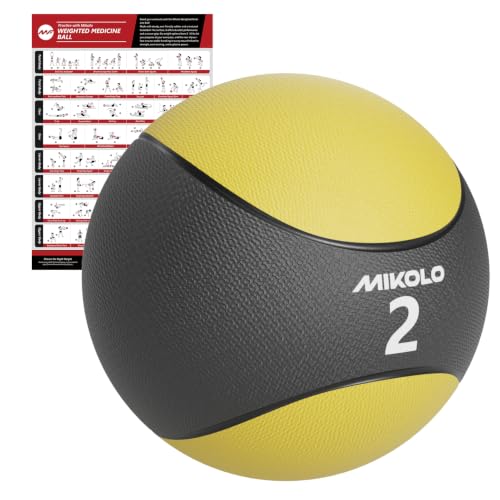
- Weight choices range from 2 to 12 pounds
- Textured rubber supports a secure grip
- Includes a posture guide and warranty support
Best For: Beginners planning gradual weight progression
Versatile Bounce Trainer
Amazon Basics 6-Pound Medicine Ball

- 6-pound rubber ball with labeled weight
- Textured grip for dynamic exercises
- Bounce capability adds workout variety
Best For: Beginners combining core work with bounce drills
Soft-Grip Wall Ball
Champion Sports Rhino Promax 6 lb

- Light 6-pound weight for approachable training
- Non-slip faux-leather Rhino Skin shell
- Designed for wall balls, not slamming
Best For: Beginners learning wall-ball and functional fitness movements
Deadweight Starter Option
ProsourceFit Slam Medicine Ball

- Non-bouncing sand-filled construction
- Waterproof PVC shell with textured grip
- 10–15 pounds recommended for new users
Best For: Beginners practicing controlled slams and full-body conditioning
Compact Non-Bounce Pick

- Light 5-pound starting weight
- Compact 9-inch diameter
- Soft rubber grip and non-bounce design
Best For: Beginners starting home-gym slams and core workouts
Balanced Starter Pick – Yes4All Sand-Filled Slam Ball
For beginners comparing slam balls for beginners, the Yes4All Sand-Filled Slam Ball offers a stable, non-bouncing design and a textured surface for controlled practice. Its PVC shell and sand-filled construction suit slams, throws, squats, twists, and other conditioning movements.
Best For: Beginners who want a dependable slam ball with several weight options for progressing strength and conditioning workouts.
Pros:
- Sand-filled design does not bounce or roll easily after impact.
- Textured surface supports a secure grip for slams, passes, and twists.
- Available from 10 to 40 pounds in multiple weight options.
Cons:
- Only one ball is included.
- The listed 20-pound model is relatively large at 9.75 inches in diameter.
This is a practical all-around choice for learning basic slam-ball movements, especially when controlled handling and weight progression matter.
Simple Two-Pack Value – Amazon Basics Slam Medicine Balls
Amazon Basics Heavy-Duty Slam Medicine Balls for Exercise, Weighted Design, 20lb, Black, 2-Pack
Check Price On AmazonAmong slam balls for beginners, the Amazon Basics Slam Medicine Balls stand out as a straightforward option for impact training. Their sand-filled PVC construction absorbs slams, while the textured surface helps maintain control during HIIT, CrossFit, and strength exercises.
Best For: Home gyms or fitness centers that need a two-ball set for controlled slams and dynamic conditioning work.
Pros:
- Heavy-duty PVC shell and sand-filled core absorb powerful impacts.
- Dead-weight design helps prevent unwanted bouncing.
- Textured, non-slip surface supports grip during sweaty workouts.
- Two balls are included in the set.
Cons:
- The supplied listing identifies the set as 20-pound balls, offering less weight-selection flexibility.
- Each ball is approximately 9.45 inches in diameter.
The two-piece format makes this a useful pick for shared training spaces or routines that benefit from having a matching pair, though it is less adaptable than a broad weight range.
Gentle Training Alternative – Core Soft Touch Medicine Ball
The Core Soft Touch Medicine Ball can suit people searching for slam balls for beginners but who primarily need a comfortable training ball for strength, balance, and recovery work. Its vegan leather surface offers a cushioned, textured grip, but it is explicitly not intended for slamming.
Best For: Beginners focused on controlled medicine-ball exercises, recovery, balance training, and gradual weight progression rather than impact slams.
Pros:
- Soft vegan leather surface feels more comfortable in the hands.
- Textured finish helps reduce slipping during exercises.
- Weight choices range from 4 to 30 pounds.
- Packed construction is designed to maintain its shape through repeated use.
Cons:
- Not intended for slamming.
- Only one medicine ball is included.
This is better viewed as a beginner-friendly medicine ball than a true slam-ball option. Choose it when comfort and versatile controlled movements are more important than impact training.
Wide-Range Progression Pick – MARCY Non-Bounce Slam Ball
For beginners choosing among slam balls for beginners, the MARCY Slam Ball combines a dead-weight, sand-filled design with a rugged textured grip. It is built for slams, tosses, and dynamic full-body exercises, with options that extend from introductory weights to heavier training loads.
Best For: Beginners and progressing athletes who want a durable, non-bouncing slam ball with a broad range of weight options.
Pros:
- Sand-filled design absorbs impact and helps prevent bouncing or rolling.
- Rugged tread texture provides a sweat-resistant grip.
- Available from 10 to 50 pounds in multiple increments.
- Durable PVC shell is designed for repeated high-intensity use.
Cons:
- Sold individually.
- The supplied listing identifies the included model as 15 pounds, so buyers should confirm the selected weight.
The MARCY is a strong choice for a long-term progression path: start with a manageable weight, then move upward as technique and strength improve.
Simple Starter Slam Ball – Fitvids 6-Pound Slam Ball
For beginners comparing slam balls for beginners, this Fitvids model offers a straightforward 6-pound starting weight for strength, conditioning, cardio, and core workouts. Its 9-inch size and medicine, slam, and wall-ball design support a range of training movements.
Best For: Beginners who want one versatile 6-pound ball for general conditioning and core training.
Pros:
- 6-pound weight is a manageable starting point for many adult users.
- Designed for medicine-ball, slam-ball, and wall-ball exercises.
- Includes a 2-year warranty and Balance From satisfaction support.
Cons:
- Only one 6-pound weight is specified, so progression requires another ball.
- At 9 inches, it is larger than some comparable weighted balls.
This is a practical introductory option when you want one clearly sized ball for varied home or gym workouts, especially if the included warranty matters.
Progressive Grip Pick – Mikolo Textured Medicine Slam Ball
Among slam balls for beginners, the Mikolo stands out for its broad weight selection and textured rubber surface. Options from 2 to 12 pounds make it easier to begin with a lighter load and progress gradually as your training improves.
Best For: Beginners who value weight progression, a non-slip grip, and varied full-body exercises.
Pros:
- Eight stated weight options range from 2 to 12 pounds.
- Textured rubber construction is designed for a secure grip and impact resistance.
- Suitable for squats, presses, lunges, push-ups, jumps, chest passes, and deadlifts.
- Includes a posture guide and manufacturer warranty support.
Cons:
- The supplied listing identifies a 2-pound yellow size, so the exact selected weight should be checked.
- Its youth age-range description may be less directly tailored to adult buyers.
The adjustable weight range makes this a flexible choice for learning technique at a lighter resistance and moving up over time, while the textured surface can help with handling.
Versatile Bounce Trainer – Amazon Basics 6-Pound Medicine Ball
This Amazon Basics ball is a useful option for people shopping for slam balls for beginners who also want bounce-based medicine-ball drills. The 6-pound rubber ball has a lightly textured surface, weight markings on both sides, and a 7.6-inch diameter for exercises such as tosses, twists, squats, and sit-ups.
Best For: Adult beginners wanting a clearly labeled 6-pound ball for core, balance, and full-body exercises.
Pros:
- Firm rubber construction is designed for repeated training use.
- Lightly textured surface supports handling during dynamic movements.
- Can bounce off hard surfaces for added exercise variety.
- Weight is labeled on both sides for quick identification.
Cons:
- Only a 6-pound version is specified, limiting built-in progression.
- The product is described as a weighted medicine ball rather than specifically as a slam ball.
Choose this model if bounce capability and easy weight identification are more important than a dedicated slam-ball design. Its compact 7.6-inch diameter also suits common core and full-body drills.
Soft-Grip Wall Ball – Champion Sports Rhino Promax 6 lb
For beginners comparing slam balls for beginners, the Champion Sports Rhino Promax offers a manageable 6-pound weight and a large 14-inch format. Its soft shell, reinforced stitching, and cushioned construction suit controlled wall-ball and functional fitness drills, though the supplied product information says it is not intended for slamming exercises.
Best For: Beginners who want a lighter wall ball for squats, presses, wall tosses, and partner exercises.
Pros:
- 6-pound weight is approachable for learning movement technique.
- Rhino Skin shell provides a comfortable, non-slip grip, including during sweaty workouts.
- Impact-absorbing construction and reinforced seams support repeated training use.
- Uniform 14-inch diameter helps maintain consistent form as resistance changes.
Cons:
- Not intended for slamming exercises.
- The large 14-inch size may feel bulky for some users.
This is a practical entry point for wall-ball training rather than a dedicated slam ball. Choose it when grip, throwing control, and a lighter resistance matter more than impact slams.
Deadweight Starter Option – ProsourceFit Slam Medicine Ball
Among slam balls for beginners, the ProsourceFit model stands out for its deadweight, sand-filled design. The manufacturer recommends starting with 10–15 pounds for better control and mechanics, while the waterproof PVC shell and textured surface are built for repeated slams and full-body conditioning.
Best For: Beginners who want a non-bouncing slam ball for learning controlled slams, throws, squats, presses, and core work.
Pros:
- Sand-filled construction minimizes bouncing and rolling after impact.
- Waterproof PVC shell helps prevent sweat buildup during workouts.
- Textured grip challenges the hands, forearms, and core.
- Available from 5 to 50 pounds for progression across training levels.
Cons:
- The listed product configuration is 20 pounds, which may be demanding for a beginner.
- Sand-filled deadweight construction can feel heavier than traditional weights.
- The shifting sand requires extra stability and control.
For a true slam-ball experience, its no-bounce behavior is a useful safety and control feature. Beginners should favor the lighter available sizes before moving to heavier options such as the listed 20-pound version.
Compact Non-Bounce Pick – REP Weighted Slam Ball 5 lb
The REP Weighted Slam Ball is a compact choice for shoppers seeking slam balls for beginners. Its 5-pound size, 9-inch diameter, soft rubber grip, and non-bounce construction make it easier to control during introductory slams, twists, lunges, and core exercises.
Best For: Beginners who prioritize a smaller, lighter ball for home-gym strength, HIIT, and core workouts.
Pros:
- 5-pound weight offers a gentle starting point for new users.
- 9-inch diameter is more compact than many larger medicine balls.
- Textured rubber shell provides a secure grip for different hand sizes.
- Non-bounce design keeps the ball controlled after each slam.
Cons:
- The 5-pound option may provide limited resistance as strength improves.
- Its smaller size may feel less substantial for users accustomed to larger wall balls.
- The listed product details do not specify waterproof construction.
This is one of the more approachable options for learning basic slam-ball mechanics. Its weight range extends up to 70 pounds, so the same product line can support progressive training as a beginner develops more power.
How We Picked the Best Slam Balls for Beginners
We focused on the features that matter most when learning slams: sensible weight choices, secure handling, non-bounce or dead-weight designs, and shells that can withstand repeated impact. We also considered whether each ball is available in multiple sizes, since beginners often need to progress gradually rather than buy a replacement after a few weeks.
Grip design received special attention. Textured rubber, soft-touch coverings, and molded or reinforced surfaces can make the ball easier to control with sweaty hands. We also favored products suited to practical home and gym movements, including overhead slams, rotational throws, carries, and controlled core exercises.
Quick Comparison
| What to Compare | Best Starting Point | Why It Matters |
|---|---|---|
| Weight | Light to moderate | Supports proper form and repeatable sets |
| Shell | Rubber or reinforced soft shell | Balances grip, comfort, and impact resistance |
| Bounce | Low or non-bounce | Improves control and reduces unpredictable rebounds |
| Grip | Textured or non-slip | Helps maintain control during fast movements |
| Weight range | Several available sizes | Makes progression easier over time |
Key Buying Factors for Slam Balls for Beginners
Choose a Manageable Weight
For most new users, a ball that allows clean technique is more useful than the heaviest option available. You should be able to lift it overhead, brace your core, and complete several controlled repetitions without arching your back or losing your grip. Lighter balls suit conditioning and faster intervals; heavier balls emphasize strength but can quickly compromise form.
Look for a Secure, Durable Surface
A textured exterior is helpful for sweaty hands and repeated catches. Rubber is generally practical for intense training, while soft-touch or coated shells may feel more comfortable for wall work and general conditioning. Check the manufacturer’s intended surface before using any slam ball on concrete, abrasive flooring, or outdoors.
Consider Bounce and Storage
Non-bounce balls are usually easier for beginners because they stay near the drop point. That makes them useful in small home gyms and reduces the need to chase the ball between repetitions. Confirm the ball’s diameter and storage requirements, especially if you have limited floor or rack space.
Who Should Buy Which Slam Balls for Beginners?
New exercisers: Choose a lighter, non-bounce model with a dependable textured grip and a weight that supports slow practice.
Home-gym users: Look for a durable ball in a moderate size that will not rebound unpredictably or damage the training area when used as directed.
Strength-focused beginners: Choose a heavier option only if you can maintain posture and control through every repetition. A wider weight range is useful for future progression.
Cross-training athletes: Consider a grippy rubber or soft-shell design that works for slams, rotational throws, carries, and conditioning circuits.
Whichever model you choose, begin with a brief warm-up, use a clear impact area, and increase weight only after your technique remains consistent. For Slam Balls for Beginners, control and repeatability are better indicators of a good fit than maximum weight.