The best adjustable orthotic insoles let you fine-tune arch height, heel positioning, or both instead of settling for a one-size-fits-all design. That flexibility can be useful for flat feet, high arches, plantar fasciitis, overpronation, and supination.
We selected 10 options ranging from layered inserts and removable pads to firm, full-length stability insoles. Use the guide below to match adjustability, support level, shoe fit, and intended use to your feet.
Best 10 Adjustable Orthotic Insoles Picks for 2026
Custom-Fit Arch Support
Guamar Adjustable Orthotic Insoles

- Three removable arch heights
- Slim 3/4-length TPU design
- Includes anti-shift heel rings
Best For: Customizable support for flat feet, high arches, and plantar fasciitis
Modular Full-Length Support
TrioPodo Adjustable Arch Insoles

- Three swappable arch support levels
- Repositionable metatarsal pads
- Deep heel cup and stability shell
Best For: Customizable full-length support for standing, walking, and work shoes
Maximum Stability Pick
PowerStep Pinnacle Maxx Insoles

- Angled heel post controls inward rolling
- Deep heel cradle adds stability
- Firm, cushioned, no-trim design
Best For: Overpronation and flat-foot support in removable-insole shoes
Customizable Arch Support
FootChair Adjustable Orthotics
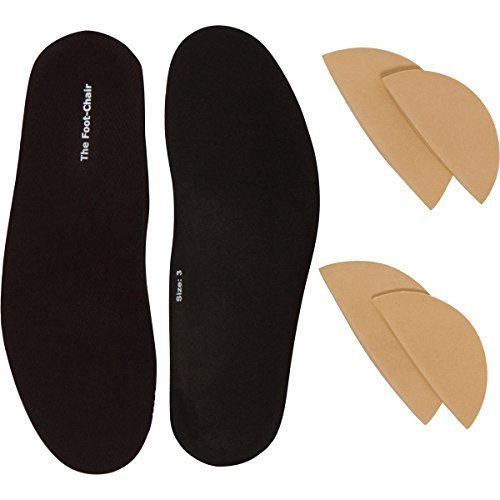
- Removable pads fine-tune arch height
- Full-length cushioning supports heel and forefoot
- Higher arch may need roomy shoes
Best For: Plantar fasciitis, flat feet, and adjustable support in removable-insole shoes
Heel Alignment Relief

- Reversible, stackable heel correction
- Slim clear silicone fits many shoes
- Supports supination and pronation
Best For: Low-profile heel alignment support for daily wear and extended standing
Three-Level Arch Support

- Three interchangeable arch heights
- 3/4-length design needs no trimming
- Washable TPU with anti-slip surfaces
Best For: Customizable everyday arch support in shoes with limited toe room
Adjustable Alignment Wedges

- Three adjustable layers for customized lift
- Medial or lateral placement for alignment support
- Silicone honeycomb surface adds grip and cushioning
Best For: Customizable heel-wedge correction for pronation or supination
Best Heavy-Duty Pick
WalkFit Platinum Orthotic Insoles

- Includes low, medium, and high arch inserts
- Gel heel cushioning with a Bio-Lock heel cup
- Available in 11 sizes for different shoe types
Best For: Adjustable arch support for everyday walking, work, and sports
Supination Support Pick

- Adjustable two-layer medial or lateral wedges
- Shallow heel cup supports a stable fit
- Sized for women’s 8–12 and men’s 7.5–13
Best For: Larger-foot users needing targeted heel-wedge alignment support
Custom-Fit Arch Support – Guamar Adjustable Orthotic Insoles
Guamar is a flexible option for shoppers comparing adjustable orthotic insoles for different arch types. Its three removable height settings, slim 3/4-length design, and TPU construction let you fine-tune support without crowding the toes.
Best For: People with flat feet, high arches, plantar fasciitis, or pronation concerns who want customizable support in several shoe styles.
Pros:
- Three adjustable arch heights accommodate low, medium, and high arches.
- Lightweight TPU offers cushioning, shock absorption, and easy cleaning.
- 3/4-length profile fits many athletic, casual, work, hiking, and boot styles without trimming.
- Includes adhesive heel rings to help keep the inserts from shifting.
Cons:
- Requires a gradual 1–2-hour daily break-in period.
- Structural support may feel firmer than soft, gel-style insoles.
- The listed size covers a specific combined men’s and women’s range.
Choose Guamar when adjustability and shoe compatibility matter most. It offers meaningful structural support in a compact format, but users should ease into wear and verify the size before ordering.
Alignment-Focused Wedges – Dr.woofeet Adjustable Heel Wedges
Dr.woofeet takes a targeted approach to adjustable orthotic insoles with stackable heel wedges rather than a full arch-support footbed. Its three-layer system lets you vary the correction angle for pronation or supination while the extended 3/4 profile helps create a smoother transition.
Best For: Users seeking adjustable gait and heel alignment support for overpronation, supination, uneven shoe wear, or related knee, hip, and lower-back discomfort.
Pros:
- Three stackable layers allow subtle or more intensive tilt correction.
- Extended 3/4 length is designed to reduce the ledge sensation of short wedges.
- High-density foam is intended to maintain its correction angle under weight.
- Honeycomb texture and adhesive help resist slipping; wedges are washable and reusable.
Cons:
- Best suited to shoes with an interior heel width greater than 5.7 cm.
- Placement under the original insole may not work in every shoe.
- A 1–3-day break-in period is recommended as alignment changes.
This is a specialized choice for users who need pronation or supination correction rather than general cushioning. Confirm shoe dimensions and start with a conservative layer setup for a more manageable transition.
Modular Full-Length Support – TrioPodo Adjustable Arch Insoles
TrioPodo is a full-length option for shoppers who want adjustable orthotic insoles with more than one support zone. Swappable arch modules, repositionable metatarsal pads, a deep heel cup, and a reinforced stability shell make it possible to tune the setup to your feet and footwear.
Best For: People with low arches, plantar fasciitis, heel discomfort, or ball-of-foot pressure who wear removable-insole boots, walking shoes, or sneakers.
Pros:
- Includes medium, firm, and max arch modules for three support levels.
- Two metatarsal pad shapes can be positioned, tested, or omitted.
- Five-plus support and comfort layers combine cushioning with a reinforced shell.
- Available in 12 sizes and includes replacement adhesive for repositioning components.
Cons:
- Designed for shoes with removable insoles and may require trimming in some cases.
- Firm structural support may feel less plush than soft cushioning-only inserts.
- DIY placement requires testing component positions before final attachment.
TrioPodo stands out for its broad adjustability: users can modify both arch firmness and forefoot pad placement. It is a strong fit for those willing to spend time dialing in support, especially for longer standing or walking days.
Maximum Stability Pick – PowerStep Pinnacle Maxx Insoles
PowerStep Pinnacle Maxx is a firm, stability-oriented choice among adjustable orthotic insoles, although its support is built in rather than user-adjustable. The angled heel post, deep heel cradle, and dual-layer cushioning are designed to help control inward rolling associated with overpronation.
Best For: People with flat feet or overpronation who want substantial heel stability and motion control in shoes with removable factory insoles.
Pros:
- Slightly angled heel post helps limit inward rolling and improve stability.
- Deep heel cradle supports motion control and heel positioning.
- Firm-but-flexible construction combines stability with dual-layer cushioning.
- Ready to wear without trimming and made in the USA.
Cons:
- Thick profile requires shoes where the factory insole can be removed.
- Provides a fixed medium-arch design rather than interchangeable support levels.
- May feel too substantial for low-volume shoes or users seeking soft cushioning.
Consider the Pinnacle Maxx when maximum stability is more important than modular adjustment. Its ready-to-wear construction simplifies fitting, but shoe volume and removable-insole compatibility are essential checks.
Customizable Arch Support – FootChair Adjustable Orthotics
These adjustable orthotic insoles are designed for shoppers who need more control over arch height than standard inserts provide. Removable pads let you fine-tune the support, while the full-length, contoured design cushions the heel, arch, and ball of the foot.
Best For: People with plantar fasciitis, flat feet, or ball-of-foot discomfort who use shoes with removable insoles and need a higher, adjustable arch.
Pros:
- Removable pads allow you to adjust the arch height.
- Full-length footbeds support and cushion the heel, arch, and forefoot.
- Firm yet flexible polypropylene helps absorb shock during walking, running, or standing.
- Designed by podiatrists as an over-the-counter alternative to custom-style support.
Cons:
- The higher-than-average arch may require a slightly larger shoe.
- They are intended for shoes with removable insoles and may not fit every shoe.
- The listed size covers a specific women’s and men’s size range.
Choose this model when adjustable arch height and full-foot coverage are priorities. Check your shoe’s available space carefully, since the pronounced arch and full-length construction can affect fit.
Heel Alignment Relief – Adjustable Gel Heel Wedges
These adjustable orthotic insoles use slim heel wedges to address supination and pronation without taking up much room in your footwear. The reversible, stackable design lets you customize inner- or outer-heel correction, while the clear silicone keeps the inserts discreet.
Best For: People seeking low-profile heel alignment support for daily walking, work, commuting, dress shoes, sneakers, boots, or extended standing.
Pros:
- Reversible and stackable wedges allow adjustable heel correction.
- Slim profile fits a range of footwear, including dress shoes and boots.
- Non-slip silicone surface helps keep the wedges in place.
- Latex-free, medical-grade silicone is designed for sensitive skin.
Cons:
- These are heel wedges rather than full-length insoles, so they do not provide full-foot coverage.
- The listed medium size fits women’s 6–11.5 and men’s 4–10.5.
- Correction is focused on heel tilt, supination, and pronation rather than broad arch adjustment.
This pair is a practical choice when heel positioning and discreet fit matter more than full-length cushioning. Its stackable format also makes it useful for gradually adjusting the level of correction.
Three-Level Arch Support – Removable TPU Arch Inserts
These adjustable orthotic insoles offer three interchangeable arch heights for low, normal, or high arches. Their 3/4-length design is intended to fit most shoes without trimming or crowding the toes, while anti-slip surfaces and adhesive heel pads help limit movement.
Best For: Men and women who want customizable arch support for sneakers, boots, work shoes, or casual footwear without removing the original insole.
Pros:
- Three interchangeable arch heights support different arch types.
- 3/4-length construction leaves more room in the toe area and requires no trimming.
- Double-sided anti-slip surfaces and included heel pads help reduce shifting.
- Washable, breathable TPU is lightweight and designed for repeated daily use.
Cons:
- The listed size is L, covering women’s 10–12 and men’s 8–13.
- The 3/4-length design does not cushion the entire foot like a full-length insole.
- Arch adjustment requires changing the interchangeable support pieces.
Consider this model if you want flexible arch-height tuning and a compact insert that can work with the shoe’s existing insole. Its washable TPU construction is convenient for regular use, while the size range should be checked before ordering.
Adjustable Alignment Wedges – Svowin 3-Layer Heel Wedges
These adjustable orthotic insoles use layered medial and lateral heel wedges to help address overpronation, supination, and uneven foot alignment. You can use the layers individually or combine them to adjust the lift, while the silicone honeycomb surface adds grip and cushioning.
Best For: Users seeking customizable heel-wedge support for pronation, supination, or alignment-related discomfort.
Pros:
- Three-layer design lets you adjust the wedge height and tilt.
- Can be positioned medially for overpronation or laterally for supination.
- Silica-gel honeycomb surface provides cushioning and anti-slip support.
- Includes black and clear pairs for use in various shoes.
Cons:
- These are heel wedges rather than full-length insoles.
- The pronounced lift may require a gradual break-in period.
- The listed size is limited to women’s 4–7.5 and men’s 6–7.
Svowin is a particularly flexible option if you want to fine-tune correction instead of committing to one fixed wedge height. Check the sizing and shoe space carefully before ordering.
Best Heavy-Duty Pick – WalkFit Platinum Orthotic Insoles
WalkFit Platinum offers adjustable orthotic insoles with three interchangeable arch inserts—low, medium, and high—plus a reflexology insert. Its Bio-Lock heel cup and gel pad add cushioning, making it a versatile choice for everyday walking, standing, work, or sports.
Best For: Men and women who want customizable arch height with heel cushioning across multiple shoe styles.
Pros:
- Includes low-, medium-, and high-arch inserts for personalization.
- Gel cushioning and a Bio-Lock heel cup support shock absorption and stability.
- Available in 11 sizes for men and women.
- Designed for sneakers, dress shoes, boots, flats, and tennis shoes.
Cons:
- Requires a gradual break-in schedule, starting at one hour on the first day.
- The product is a full insole and may need sufficient shoe room.
- Its alignment and pain-relief results can vary by user.
With multiple arch options and broad shoe compatibility, WalkFit Platinum is the most adaptable pick here for shoppers who want arch support rather than a targeted medial or lateral heel wedge.
Supination Support Pick – BIGGCOOL Heel Wedge Inserts
These adjustable orthotic insoles are designed as medial and lateral heel-wedge inserts for supination, overpronation, and uneven alignment. The two-layer construction lets you use the wedges individually or together, while the shallow heel cup and PU gel material provide a more stable fit.
Best For: Larger-foot users looking for adjustable heel-wedge support for supination, overpronation, or bow-leg alignment concerns.
Pros:
- Two-layer design allows the correction level to be adjusted.
- Shallow heel cup helps fit the foot’s curve and improve stability.
- Medical-grade PU gel and a honeycomb cloth surface provide cushioning and grip.
- Fits women’s sizes 8–12 and men’s sizes 7.5–13.
Cons:
- These are heel-wedge inserts, not full-length insoles.
- Only a two-layer configuration is included.
- Large sizing may not suit smaller feet.
BIGGCOOL makes sense for shoppers who need targeted heel-wedge correction in a larger size range. Its shallow cup and adjustable layers offer useful stability, but confirm that your shoes can accommodate the added heel height.
How We Picked the Best Adjustable Orthotic Insoles
We compared these Adjustable Orthotic Insoles by the type and range of customization they offer, including removable arch layers, heel wedges, medial or lateral posting, and replaceable pads. We also considered support firmness, heel stability, cushioning, full-length versus partial designs, and whether each option targets common alignment concerns such as overpronation or supination.
Because foot shape and symptoms vary, no insole is universally best. Product sizing, shoe compatibility, and gradual break-in requirements also matter, so check the manufacturer’s measurements before ordering.
Quick Comparison
| Best for | Look for | Typical design |
|---|---|---|
| Adjustable arch height | Removable layers or pads | Layered arch inserts |
| Overpronation | Medial support and firm heel control | Posted or structured orthotic |
| Supination | Lateral correction and cushioning | Heel wedge or alignment insert |
| Maximum stability | Firm shell and reinforced heel | Full-length orthotic |
| Everyday comfort | Moderate support and shock absorption | Cushioned insole |
Key Buying Factors for Adjustable Orthotic Insoles
Adjustment Method
Removable layers are useful when you are unsure how much arch height you need. Heel wedges are more targeted: medial wedges generally address inward rolling, while lateral wedges are commonly used for outward rolling. Follow the product instructions rather than stacking components arbitrarily.
Support and Cushioning
Firm materials provide more structural control, but they may require a longer break-in period. Softer gel or foam can feel comfortable immediately but may compress sooner or offer less correction. For plantar fasciitis, prioritize a supportive heel cup and stable arch rather than cushioning alone.
Fit and Shoe Compatibility
Full-length insoles work best in removable-insole shoes with enough volume. Three-quarter or heel-only inserts can fit dress shoes and tighter footwear more easily. Never force an insole into a shoe if it crowds the toes, lifts the heel, or causes rubbing.
Break-In and Safety
Start with short periods of wear and increase gradually. Stop if pain, numbness, blistering, or worsening symptoms develops. People with diabetes, significant foot deformity, circulation problems, or persistent pain should ask a qualified clinician before using corrective inserts.
Who Should Buy Which Adjustable Orthotic Insoles?
- Choose layered arch inserts if you want to experiment with different support heights for flat feet or high arches.
- Choose heel wedges if your main concern is pronation, supination, or a specific alignment adjustment.
- Choose a firm full-length orthotic for demanding work, walking, or sports when stability matters more than plush cushioning.
- Choose a cushioned adjustable design for everyday wear when you need moderate support and impact absorption.
- Choose a clinician-guided option if pain is severe, one-sided, persistent, or associated with an injury.